Showing posts with label Nuclear. Show all posts

7/02/2011

(July 1*) Fukushima Disaster Shows Nuclear Power Is Never 'Safe'

By JIM RICCIO

Posted: July 1, 2011

Jim Riccio is a nuclear policy analyst for Greenpeace.

The ongoing nuclear disaster at the Fukushima nuclear plant will be delivering up many lessons to those willing to listen. More than three months after the earthquake, tsunami, and subsequent meltdown of three nuclear reactors, TEPCO, the nuclear corporation that owns the plant, is no closer to controlling the meltdowns or securing 20 years of radioactive material at risk in the waste pool. A few things, however, are becoming clear.

Nuclear power is never "safe." Splitting atoms to produce heat, boil water, and generate electricity is an inherently dangerous activity. Splitting atoms can be made less dangerous, but it can never be "safe." The 104 nuclear power plants in the United States and the 440 operating around the world all carry the threat of a catastrophic meltdown with devastating consequences. To claim this technology is safe is no more than atomic hubris. Nuclear power plants will fail, and when they do, the consequences are catastrophic for individuals and society. As the codiscoverer of the DNA molecule once put it, "the idea that the atom is safe is just a public relations trick." [Read more about energy policy and climate change.]

Fukushima has reminded us, too, that probability will not protect the public from nuclear meltdowns. Long before the disaster at Fukushima, I recommended that U.S. nuclear regulators read Nassim Nicholas Taleb's The Black Swan. Taleb addresses the impact of low-probability, high-consequence events such as Fukushima and points out the psychological trap of relying on probability to protect us. Taleb has intentionally avoided doing interviews on the Fukushima fiasco, but wrote:

I spent the last two decades explaining … why we should not talk about small probabilities in any domain. Science cannot deal with them. It is irresponsible to talk about small probabilities and make people rely on them, except for natural systems that have been standing for 3 billion years (not manmade ones for which the probabilities are derived theoretically, such as the nuclear field for which the effective track record is only 60 years).

Probability provides cold comfort when reactors are overwhelmed by forces they were never designed to resist—such as the meltdown of the radioactive fuel rods that make up the core of the nuclear reactor. But the nuclear industry and its regulators have been doing precisely what Taleb warns against. [See a slide show of 10 cities with the most Energy Star-certified buildings.]

As has been well documented by the Associated Press, the New York Times, Huffington Post, ProPublica, and others, the Nuclear Regulatory Commission, or NRC, has been captured by the nuclear industry and has been in regulatory retreat for over a decade. At the behest of the industry, the NRC has been busy deregulating safety standards based on the probability that the Black Swan, i.e., a meltdown, will not occur. Sadly, these same regulators have ignored the flaws in their risk assessments. According to NRC documents, between 42 percent and 59 percent of the most risk-significant accident scenarios aren't even modeled in nuclear risk assessments. The NRC and the nuclear industry have relied on risk models that leave them half blind to the very events they're attempting to avoid.

Despite recognized flaws in their risk assessments, government regulators have allowed the nuclear industry to whittle away at regulations intended to protect the public in order to reduce the cost of producing electricity with nuclear reactors. As a result, safety has been compromised. The nuclear bureaucrats have lost sight of their safety mission and instead have weakened nuclear plant regulations to allow reactors to run longer and harder than ever before. Government officials have repeatedly placed corporate profit ahead of public safety. In order to increase the corporate bottom line, the public has been exposed to greater risk while the industry is exposed to less regulation. All the while, these corporations and captured regulators claim splitting atoms on a shoestring is "safe." [Check out a roundup of political cartoons on energy policy.]

As we saw at Three Mile Island, Chernobyl, and now Fukushima, nuclear power is never "safe." The improbable happens, and regulations put in place by nuclear bureaucrats are insufficient to the catastrophe. Probability will not protect the public from the consequences of a nuclear meltdown. The nuclear industry's practice of lulling regulators into complacency based on low probability of a meltdown is irresponsible at the least. Rather than promoting the expanded use of nuclear power, government regulators will be lucky if they can manage the end of the nuclear age and secure deadly radioactive wastes without more Black Swan events like the fiasco at Fukushima.

* Retrieved from http://www.usnews.com/opinion/blogs/energy-intelligence/2011/07/01/fukushima-disaster-shows-nuclear-power-is-never-safe

* color added by the blogger

6/10/2011

(June 8*) Switzerland Nuclear Power Phaseout Approved By Lawmakers

BY PHILIPPE CLAVEL 06/ 8/11 07:45 AM ET

BERN, Switzerland -- Swiss lawmakers approved a proposal Wednesday to phase out the use of nuclear power, a move spurred by election-year politics and growing skepticism over the use of atomic energy.

A majority of parliamentarians in Switzerland's lower house voted in favor of a gradual plan to shut down the country's five nuclear reactors by 2034.

The ballot passed the National Council with 101 votes in favor, 54 against and 36 abstentions. It had the support of all parties except the pro-business Liberal Democrats and the nationalist Swiss People's Party.

Switzerland's nuclear plants currently generate almost 40 percent of the country's energy. Hydropower supplies most of the rest.

Opponents had warned that abandoning nuclear power would require a massive increase in conventional and alternative energy generation, raise electricity costs for consumers, endanger Switzerland's efforts to reduce carbon emissions, and make the country more dependent on foreign suppliers of natural gas.

Switzerland's upper house, the Council of States, must also approve the plan, then the government will have to submit a detailed proposal on exiting nuclear power to parliament. The Cabinet is already in favor of decommissioning the country's reactors between 2019 and 2034, after they reach an average lifespan of 50 years.

Efforts to abandon nuclear power in Switzerland were boosted following the disaster at Japan's Fukushima Dai-ichi nuclear power plant, which was partially destroyed by a March 11 earthquake and tsunami.

Although Switzerland's reactor are considered safe and the country isn't prone to large natural disasters, opinion polls showed most Swiss favored shutting down the nuclear plants. The issue threatened to dominate the political debate ahead of parliamentary elections on Oct. 23.

Last month, demonstrators held the biggest anti-nuclear protest in Switzerland in 25 years.

"Be constructive. We can do this," Energy Minister Doris Leuthard told lawmakers after the vote Wednesday.

Suggestions for increasing power in Switzerland include buying more natural gas and developing more water, sun and wind energy resources, plus geothermal and other small-scale power generating efforts.

Leuthard noted that many small infrastructure projects in Switzerland are blocked at the local level. The country's unique system of popular democracy makes it easy for voters to stop wind farms and other alternative power plants being built in their own backyard.

On Monday, Switzerland's northern neighbor Germany approved abolishing nuclear power by the end of 2022. The law now goes to both houses of the German parliament, which are expected to vote on the plans within a month.

Germany has 17 nuclear power plants but shut down eight of the oldest ones for good after the Fukushima disaster.


Retrieved from http://www.huffingtonpost.com/2011/06/08/switzerland-nuclear-power_n_873012.html

* color and emphasis added by the blogger

(June 7*) In Germany’s Nuclear Phase-Out, Renewable Energy Plans Are Clear

By Jennifer Morgan on June 7, 2011

Chancellor Angela Merkel arrived in the United States yesterday to be presented with the Presidential Medal of Freedom, coming shortly after her announcement that Germany plans to phase out nuclear energy by 2022 and accelerate the transition to a clean energy system largely built on renewable energy and energy efficiency. Jennifer Morgan analyzes the steps the country is taking to move to a low-carbon, non-nuclear future.

Chancellor Merkel’s announcement last week that her conservative government planned to accelerate the phase-out of nuclear power seemed to catch many around the world by surprise and create a fair amount of skepticism. Some painted it as a “panicked overreaction” and a “knee-jerk reaction” to the nuclear meltdown in Japan.

With the focus on the nuclear phase-out, there has been less attention paid to the fact that Germany’s new energy plan is also an accelerated phase-in of renewable energy and energy efficiency. It is wise to take a closer look at the decision to understand how the world’s fourth largest economy plans to succeed with this new energy plan while at the same time sticking to its ambitious climate change goals and laws.

Far from a short-sighted political reaction to the nuclear crisis, Germany has put in place the laws, infrastructure and has the public support to make this transition happen.

The Roots of Germany’s Energy Transition

Yesterday, Merkel’s Cabinet agreed on a package of energy laws to implement the Chancellor’s announcements, and sent the package to the Parliament for a vote by the 8th of July. After some negotiation, the governors of Germany’s sixteen states unanimously approved the package last Friday. Given that the governors represent a broad consensus of all political parties, it is likely that the proposed acts will move quickly through the parliament and be implemented. The Cabinet decision also stresses that Germany remains committed to its ambitious climate change targets of reducing greenhouse gas emissions by 40% in 2020, compared to 1990 levels.

The latest decision by Chancellor Merkel’s government builds on a transition that had already been agreed upon in principle and was well underway over the previous years.

The German decision should be viewed in the context of an energy transition that began two decades ago. The first version of Germany’s feed-in law to encourage renewable electricity generation entered into force in 1991 and was expanded into a more comprehensive Renewable Energy Act in 2000. The initial decision to phase out nuclear power was taken in 2000 by the then Social Democrat/Green Party governing coalition. Last autumn, the new conservative government decided to continue with the phase-out, but modified the schedule in order to extend the lifetime of nuclear plants. The latest decision by Chancellor Merkel’s government accelerates the timeline for phase-out again, and builds on a transition that had already been agreed upon in principle and was well underway over the previous years.

Studying the Feasibility and Setting Ambitious Goals

Over the last two decades, there has been significant study and discussion in Germany about how to achieve such a transition and just how achievable its ambitious energy transition goals are. In the last year alone, a number of studies considered scenarios for Germany’s energy future:

  • A detailed scenario developed by Germany’s Federal Environment Agency found that a 100 percent renewable energy system by 2050 was technically feasible and outlined the necessary steps to create this energy system. In a report released last week, the Agency also found that a nuclear phase-out by 2017, even faster than the current government plans, would be feasible without negative climate impacts.

  • An expert advisory panel to the German government, the German Advisory Council on the Environment, also studied “Pathways to a 100% Renewable Electricity System”. According to the different scenarios analyzed, that goal would be reached by 2050, while in 2020 renewables would already account for around 50 percent of electricity consumption. The Advisory Council also looked at the environmental, economic and energy security impacts of a fully renewable energy system and characterized it as “climate-friendly, reliable, [and] affordable”.

  • A number of leading academic research institutes as well as NGOs have also been assessinglong-term and short-term energy and climate scenarios that phase out nuclear power soon, while meeting ambitious climate change goals.

  • The German government also commissioned feasibility studies when it prepared for a new long-term energy concept in the fall of 2010. After the accidents in Japan, the government asked a high-level panel of independent experts, chaired by Klaus Toepfer, former head of the United Nations Environment Program, to assess the ethics of energy technology choices. In its final report, the commission made recommendation for Germany’s energy situation post-Fukushima and recommended to focus on the transition to renewable energy sources, while phasing out nuclear energy by 2021.

Against this background of detailed feasibility studies for different energy futures, the German government approved an energy concept in the fall of 2010. It set Germany on the track to achieve 40 percent greenhouse gas reductions and a share of 35 percent renewable energy by 2020 and 80 percent greenhouse gas reductions with 80 percent renewable energy in 2050. The accelerated nuclear phase-out modifies this energy concept, but keeps these targets intact.

Smart Energy Policy, Smart Economic Policy

Germany’s decision to phase out what it sees as a less-desirable technology, while continuing to tackle climate change, can provide important lessons for other countries. Due to the success of renewable energy and energy efficiency in the country, it is in a strong position to choose this pathway. Germany has almosttripled its share of renewables in its final energy consumption from 3.8 percent in 2000 to 11 percent in 2010. Renewables have even been growing faster than most studies predicted in the past.

This has also been an economic success story: In the last five years, investments in Germany’s clean energy sector grew by over 75 percent, creating a dynamic industry that supports 367,000 jobs. In 2009, Germany was third in installed renewable energy capacity and has invested more in future capacity than any other country.

A recent IPCC report finds that by 2050, nearly 80 percent of the world’s energy could come from renewable sources. This is not science fiction, but smart energy and climate policy that also creates jobs, exports and economic growth.

A Global Shift Towards Clean Energy

Germany is not the only country making these kinds of decisions. The government of Japan, still reeling from the tsunami and nuclear disasters, has signaled that it plans to increase its share of renewable energy. The United Kingdom recently announced a 50% GHG reduction target by 2025. China as well has been developing impressive renewable energy and efficiency targets and policies. The decisions to shift to clean energy in these cases emerges in part from a desire to move from what is understood by society to be more risky energy sources, be they nuclear, coal, or oil, towards new possibilities in renewable energy instead.

Countries that are either skeptical of the effectiveness of renewable energy and efficiency to meet energy needs – and thus are doing little to move in this direction – or are planning large-scale investments in new energy sources may learn from these examples.

Retrieved from http://www.wri.org/stories/2011/06/germanys-nuclear-phase-out-renewable-energy-plans-are-clear

* color and emphasis added by the blogger

(May 30*) Getting nervous about nuclear power

From Tuesday's Globe and Mail

The meltdown at Japan’s Fukushima power station unleashed a wave that threatens to swamp the nuclear industry’s much-hyped global renaissance, although many governments insist nuclear remains a favoured option as they face hard choices over future energy supply.

German Chancellor Angela Merkel jolted the nuclear industry on the weekend with her announcement that Europe’s industrial powerhouse will close all 17 of its nuclear reactors by 2022, pulling the plug on a technology that until recently supplied Germany with 23 per cent of its power.

The announcement is bound to send further shock waves through an industry grappling with the consequences of the Fukushima disaster. It will certainly cause casualties – both directly as some governments back away from their nuclear ambitions, and indirectly, by forcing the industry to improve its safety technology, further raising the already daunting price of new reactors.

Should governments move away from nuclear energy on a large scale, it’s not clear how they will make up for the loss in capacity without relying more heavily on fossil fuels such as coal and natural gas, which experts warn are key contributors to an impending climate catastrophe.

Environmentalists are urging consumers to be more efficient in the way they use energy, while calling for heavy investment in renewable energy sources such as wind and solar. But as potentially devastating as they are, governments, industry and utility planners for the most part remain more comfortable with the risks posed by nuclear power than the uncertainties of relying on an entirely re-engineered system.

In short, the nuclear era is far from over. But the fact remains that the crisis at the Japanese plants has reawakened fears that had dissipated in the years since the Chernobyl disaster in the former Soviet Union.

Indeed, the nuclear industry has lately insisted that there is a renaissance in interest in its product. The key to that resurgence lies not in Germany but elsewhere, in nuclear-dependent France and Sweden, and in the United States, China, India and South Korea – all of which are pursuing ambitious nuclear construction programs. Southeast Asia and the Middle East, where governments in emerging economies like Malaysia and Turkey have embraced nuclear energy, are also key to the industry’s future.

In Canada, Ontario remains committed to a policy that has resulted in nuclear plants supplying 50 per cent of the province’s energy, compared with 15 per cent in the country as a whole. Both the governing Liberals and opposition Progressive Conservatives endorse a plan to build two new reactors and refurbish aging ones. Quebec – which is blessed with abundant hydro power – is meanwhile backtracking on a plan to retool its Candu reactor at the Gentilly-2 plant.

Has Germany Set a Precedent Other Countries Will Follow?

Ms. Merkel’s announcement was, in fact, a reversal of a decision made only a year ago to extend Germany’s nuclear era. Under the influence of a popular Green Party, Germany had planned to shut down its reactors, but Ms. Merkel passed legislation just last year to allow utilities to extend the life of existing plants.

In the wake of the Fukushima disaster, her weekend decision essentially reverts to a previous plan to shutter the country’s reactors by 2022. Industry experts do not expect other governments to follow suit, noting that the German government is known for its ambivalent attitude toward nuclear energy. Said Greg Barnes, an industry analyst with TD Securities Inc.: “Germany has long been regarded as ‘weak’ on nuclear power and was not expected to be a significant factor in reactor growth over the medium to longer term.”

Hans Blix, former head of the International Atomic Energy Agency, said he is sticking to his view that the Fukushima disaster will prove to be a “bump in the road, but not the end of the road” for nuclear power around the world.

But Germany’s about-face nonetheless illustrates the new level of caution with which governments are approaching nuclear power. Reporting last weekend, a government-appointed German commission urged the total withdrawal from nuclear energy, saying Fukushima “demonstrates the limitations of human disaster-preparedness and emergency measures.” It said risk levels are unacceptable given the existence of other, safer alternatives.

And while other governments may want to proceed with plans for new reactors, citizens may make their own risk assessment and throw up roadblocks when utilities look for regulatory approval.

At the very least, the Japanese disaster will force the industry to increase its level of safety, forcing costly design changes. “As the industry was attempting to put the renaissance into practice, you were seeing the cost estimates just going up and up and up,” said Mark Winfield, a professor of energy and environment at York University.

“So the renaissance was already in some difficulty before this happened, but this is clearly taking it to a new level.”

How is the Global Nuclear Industry Responding to Fukushima?

Though no one in the industry wants to publicly blame Tokyo Electric Power Co., which owns Fukushima, they will point out that the plant was 40 years old and was not built to withstand the devastating combination of massive earthquake and giant tsunami that overwhelmed its emergency systems. Ontario Power Generation chief executive Tom Mitchell is chairing a committee of the World Association of Nuclear Operators to examine the Fukushima accident and offer recommendations to the industry.

Around the world, regulators have ordered operators to reassess their safety systems. In the United States, the Nuclear Regulatory Commission found that nearly a third of the country’s 104 nuclear plants are ill-prepared to meet serious and simultaneous emergencies.

In a report to the Canadian Nuclear Safety Commission filed last Friday, Ontario Power Generation, the provincially owned utility, said there were “no significant safety issues requiring immediate corrective or compensatory measures” at its Darlington and Pickering stations east of Toronto. But it added it would reduce the risk of fire by speeding up the installation of equipment needed to vent hydrogen, the buildup of which caused explosions that were a significant factor in the disaster at Fukushima. OPG will also review the way it stores contaminated fuel rods to lessen the risk should fire break out.

Industry officials point out that new reactors have safety features that did not exist at Fukushima, including cooling systems that rely on gravity rather than an outside power source, the failure of which was another critical factor in the accident at the Japanese plant.

What Impact Would Nuclear’s Decline Have on Climate Change?

Most government and industry experts have concluded that nuclear energy is a critical component of the effort to reduce carbon dioxide emissions and limit the impact of climate change. In its scenario for reducing greenhouse gas emissions by 50 per cent by 2050, the International Energy Agency says nuclear’s share of the global power supply would have to grow to 24 per cent from 14 per cent currently to achieve that goal.

Some environmentalists are willing to accept that nuclear power should play a significant role in mitigating the effects of global warming, but most still oppose it, citing concerns about safety, waste management and weapons proliferation.

Graham Saul, executive director of Climate Action Network Canada, noted that nuclear energy would not be commercially viable if the industry were required to cover its liabilities. Like most industrialized countries, Canada has legislation that caps liabilities in the event of accident.

Can Renewables Replace Nuclear?

Germany’s move to shutter its nuclear plants is a vote of confidence in the renewable energy industry, which is generally seen by governments and industry as incapable of providing a base load of reliable and affordable power.

“You see a lot of naysayers out there saying its too expensive and it can’t be done. But now you are seeing a country saying it can be done,” said Kent Brown, chief executive officer of BluEarth Renewables Inc., a Calgary-based startup that is investing in wind and other green power projects. “This is an example of a developed country with a commitment to renewables.”

Germany plans to cut its power consumption and rely more heavily on offshore wind, as well as solar, and is confident that it can make the transition over a reasonable period of time. It says it will sharply increase the amount of renewable energy in its portfolio from the current 17 per cent, while cutting power consumption by 10 per cent through conservation measures.

In Ontario, where most of Canada’s nuclear plants are located, it would actually be easier to shift to renewables than in Germany, said Tim Weis, director of renewable energy and efficiency policy at the Pembina Institute, a Calgary-based environmental think tank. That’s because Ontario has fewer consumers than Germany and more reliable renewable-energy resources – mainly wind and sunlight.

But critics say renewables remain too unreliable and expensive to provide secure, base-load power – and will remain so until major technological advances are made that allow energy from inconsistent sources to be economically stored and recovered.

Andres Carlgren, Sweden’s Environment Minister, criticized the German plan as “unrealistic.” All it means, he said, is that Germany will now have to rely more heavily on coal and on imports of nuclear-generated electricity from France.

Retrieved from http://www.theglobeandmail.com/report-on-business/international-news/getting-nervous-about-nuclear-power/article2040659/singlepage/#articlecontent

* color and emphasis added by the blogger

5/20/2011

(May 19*) In disaster there is opportunity: How the Fukushima disaster is leading to a more sustainable future

May 19, 2011

By Johanne Whitmore, Energy Policy Analyst

We often get stuck in our ways, and only after receiving a whack to the head do we finally realize it's time for change. This is precisely what happened to German Chancellor Angela Merkel, the leader of the politically conservative Christian Democratic Union, and long-time proponent of nuclear energy. It seems the disaster at the Fukushima nuclear power plant in Japan has caused her to question her scientific understanding of the risks associated with nuclear power.

Only last year, Merkel wanted to extend the operating life of Germany's nuclear reactors by approximately 12 years. After the Fukushima disaster, she announced to everyone's surprise that her government will instead accelerate the phasing out of German reactors by 2022 at the latest. And she didn't stop there. She also vowed to slash the use of coal, speed up approvals for renewable energy investments, and cut CO2 emissions by 80 per cent by 2050.

Like many other government leaders, Merkel was convinced that nuclear power was safe and clean. But unlike many politicians, she is a trained physicist and received a doctorate for her work in quantum chemistry. That's what makes Merkel's about-face on nuclear so extraordinary; she has the scientific credentials and certainty to support her views. But, the disaster at the Fukushima nuclear plant in Japan was a game-changer. And Merkel, before anyone else, now understands the urgency of ending the use of nuclear and coal energy to instead embrace an age of renewable energy.

Fortunately, Merkel isn't alone in bringing about this change. Recently, Japanese Prime Minister Naoto Kan announced he will forgo plans to get half of the country's future energy needs from nuclear power and instead place a greater reliance on renewable energy sources. This change of heart is not only due to the environmental and social costs of the disaster, but also the mounting economic costs. The Japanese government could end up paying out approximately $200 billion in order to cover the costs associated with nationalizing the nuclear company and compensation claims. Kan declared that "there's a need to start from a clean slate in discussing the basic energy plan." In disaster there is opportunity. We hope that Prime Minister Kan's words of wisdom will serve as a hard lesson to all governments, especially Canada's, where we have yet to put forward a sustainable, long-term plan for energy and climate change.


Retrieved from http://www.davidsuzuki.org/blogs/climate-blog/2011/05/in-disaster-there-is-opportunity-how-the-fukushima-disaster-is-leading-to-a-more/

* color and emphasis added by the blogger

5/10/2011

(May 9*) Nuclear Power: Not the Solution to Climate Change

09.05.11

by Elizabeth A. Stanton and Frank Ackerman

If carbon emissions from energy production are the problem, is nuclear power the solution? After all, nuclear reactors split uranium atoms to generate heat; no fossil fuels are used on site, and no CO2 is released into the air from the power plant itself. Plenty of voices can be now heard advocating construction of nuclear plants in order to save the environment. The Obama administration supports new loans and incentives for nuclear power, as does the Kerry-Lieberman climate and energy bill.

It's not quite that simple. The nuclear power life cycle includes many steps, from mining and enriching uranium, building the reactor, operating the plant, processing and disposing of the spent fuel, through, someday, decommissioning the plant when it can no longer be used. Many of these stages are quite energy-intensive, so there are life-cycle greenhouse gas emissions from nuclear power. The best available data show the life-cycle emissions from nuclear power to be much lower than from fossil fuel-burning power plants, but equal to or higher than the emissions from renewable energy, such as solar, wind, and hydro-power.

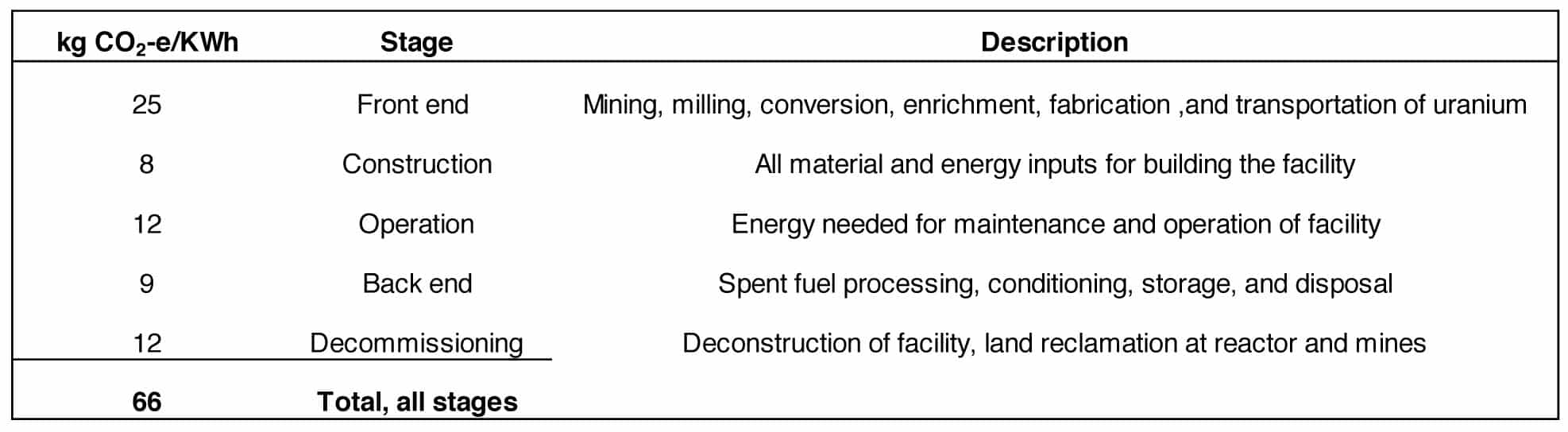
A comprehensive literature review by Sovacool (2008) screened the available studies on greenhouse gas emissions from nuclear power, identifying 19 studies that met several criteria for reliability. The table shows the average carbon emissions across these studies for the five major stages of the nuclear life cycle, in metric tons of CO2-equivalent (CO2-e) per megawatt-hour (MWh).

Carbon emissions for five major stages of the nuclear life cycle
Table: Carbon emissions for five major stages of the nuclear life cycle
Source:
Sovacool (2008).

The same literature review reported estimates of life-cycle emissions from renewable electricity generation ranging from 9 to 41 mT CO2-e per MWh, with wind and hydropower at 9 to10, and photovoltaics at 32. Fossil fuel-burning plants, in contrast, ranged from about 440 mT CO2-e per MWh for natural gas combined cycle turbines, up to 1,050 for some coal plants. Thus nuclear power has much lower life-cycle greenhouse gas emissions than fossil fuels, but higher than leading renewable technologies.

There are a number of uncertainties in estimating emissions from the nuclear fuel cycle. The quality of uranium ore makes a big difference; mining and processing ore with lower concentrations of uranium uses more energy per MWh of electricity. The choice of enrichment technology is also important; much of the world uses gas centrifuges, which require much less energy than the gas diffusion technology used in the United States. Finally, the end of the nuclear life cycle, encompassing the disposal of spent fuel and other radioactive waste, along with decommissioning of retired reactors (parts of which are by then radioactive), remains a subject of guesswork, with the siting, design, and construction of a final waste repository still an unsolved problem.

With all this in mind, how does nuclear power measure up to the alternatives? On grounds of greenhouse gas emissions alone, nuclear power looks like a big improvement over fossil fuels, with about 15 percent of the emissions (per MWh) of efficient natural gas-burning plants. On the other hand, wind and hydro-power have about 15 percent of the emissions of nuclear plants; photovoltaics may have half the emissions of nuclear power.

Meanwhile, there are a host of other questions about nuclear power, which would have to be answered if it were to become a bigger part of our energy system. The safety concerns, from the era of the Three Mile Island and Chernobyl accidents, may be the least of the current problems; improvements in U.S. reactor operations have led to fewer outages and more reliable performance in recent years. Reactors remain staggeringly complex systems, in which the myriad possible pathways to failure cannot all be anticipated and planned for in advance, but for now, they appear to be under control. New reactor designs may allow for safer operations in future plants.

Safety, however, is not cheap; the price of making a reactor reasonably safe drove construction costs far up into the billions of dollars, bankrupting some of the original investors and raising the price of electricity from nuclear plants. It is vitally important to avoid the temptation to make nuclear power more affordable by cutting corners on safety -- as the recent Deepwater Horizon oil rig explosion in the Gulf of Mexico has amply demonstrated, expensive environmental and safety regulations are adopted for very good reasons.

Nuclear power plants are also thirsty: Huge volumes of cooling water are required to keep temperatures under control. Heat waves and droughts have forced cutbacks in nuclear power production, in both the United States and Europe, in recent years. All thermal power plants, whether fossil fuel-burning or nuclear, require cooling water, but nuclear power requires the most of all. According to a U.S. Department of Energy study, nuclear plants with closed-loop cooling (recycling water within the plant instead of using it once and then returning it to its source) consume 720 gallons of water per MWh of net power produced; the comparable figures are 310 to 520 gallons per MWh for several types of coal plants, and 190 gallons per MWh for natural gas combined-cycle plants.

Investing in a technology that needs a lot of cooling water seems less than ideal in a world in which climate change is making many areas hotter and drier. The hottest days of the summer are the times of peak electricity demand, when every air conditioner is turned on -- not a time when major power plants should be going off-line.

Finally, the nuclear waste problem won't go away. The federal government has promised to build a permanent disposal site, but has failed to do so; as a result, ever-growing numbers of spent fuel rods are being stored in ponds near nuclear reactors around the country. Some of the wastes produced by nuclear power will be dangerous for thousands, if not tens of thousands, of years -- an environmental hazard that is even longer-lived than the climate crisis. Until this problem is solved, and the cost of the solution is known, nuclear power can't be a dependable answer to our energy needs today.

Retrieved from http://mrzine.monthlyreview.org/2011/sa090511.html

* color added by the blogger